Estimated reading time: 10 minutes.
Most “how to buy from Yiwu” content stops at “go to the market, negotiate hard.” That’s useless if you’re an e-commerce seller with a $5,000 test budget and no idea which of 75,000 booths to trust. This is the process that actually works for small buyers — the same one used by professional sourcing agents, written out stage by stage.
(If you don’t know what Yiwu is, start with Inside Yiwu: How the World’s Largest Small-Commodity Market Actually Works, then come back.)
Stage 1 — Prepare before you contact anyone
Work backwards from money, not products:
- Target landed cost = (your retail price) − (platform fees + fulfillment) ÷ (your target margin). If a SKU can’t hit it, drop it now.
- Compliance requirements for your market: CPC for children’s products (US), CE/UKCA (EU/UK), RoHS for electronics. Write them into your spec sheet — don’t “check later.”
- A written spec per SKU: material, dimensions, weight, colorfastness, packaging. Chinese suppliers deliver precisely what is specified — and precisely what is not.
Stage 2 — Scout (or pre-screen remotely)
If visiting: walk your target district fully before buying anything. Collect booth cards, photograph candidates with booth numbers, and don’t negotiate seriously on day one — quotes given to a wandering stranger are tourist prices.
If remote: shortlist via the official Chinagoods platform or a sourcing agent, and order paid samples (¥10–50 for in-stock counter samples; ¥200–800 for made-to-order pre-production samples, often credited against the order). Ship samples to your address before committing. Photos lie — especially about fabric weight and plastic finish.
A key calibration point: the same product often appears in 20+ booths because they source from the same 2–3 factories. Price spread within a category is usually 10–20%, not 300%. If one booth is dramatically cheaper, ask why before celebrating.
Stage 3 — Verify every serious supplier
For each shortlisted booth:
- Business license (营业执照) — every booth must display one. Verify the registered entity name matches whoever will receive your payment.
- Export capability — which licensed export agent do they use? Get the name early.
- Factory relationship — for OEM orders, ask for a factory video call and product-specific test reports (EN71, ASTM, CE, RoHS as relevant). Template documents with the product name retyped are a red flag.
Stage 4 — Negotiate the package, not just the price
Quantity and repeat intent move prices more than haggling theater:
“I’ll take 200 cartons now and reorder quarterly if the first shipment sells.”
Then negotiate the whole envelope: payment terms, custom packaging, a 2–3% spare-parts allowance for fragile goods, sample-fee credit. Get a proper quote sheet (报价单): SKU, material, dimensions, carton size, units per carton, price at stated quantity, FOB port. That sheet is the skeleton of your contract.
Stage 5 — Choose your agent and payment structure
Here’s the structural fact most guides skip: most Yiwu booths cannot receive foreign currency. Your money flows through a licensed export agent or the market’s official trade services company, who consolidates purchases from dozens of booths, settles in RMB, and declares customs — often under Yiwu’s simplified market-procurement regime (code 1039). This is normal, not a red flag. But it makes agent choice the highest-leverage decision you’ll make.
Payment terms you’ll actually encounter:
| Terms | When it’s reasonable |
|---|---|
| 30% deposit / 70% before shipment | Standard for made-to-order |
| 100% before shipment | Standard for small in-stock orders via agents |
| 100% against B/L copy | Only for long-trusted repeat relationships |
Iron rules: pay only verified corporate accounts (a request to pay a personal WeChat/Alipay wallet for a large sum is a warning sign), and never pay the balance before inspection.
Stage 6 — Inspect before the container closes
Either attend the consolidation warehouse yourself, or hire a third-party inspector (¥200–400 per man-day in Yiwu; book 2–3 days ahead). Check:
- Quantity per carton against the packing list (random-open several cartons — stuffing shortfalls are the most common “quiet” loss)
- Workmanship sampled against the golden sample you retained
- Packing integrity, label and marking compliance
Stage 7 — Ship
| Mode | Transit (US/EU) | Best for |
|---|---|---|
| Sea LCL | 30–45 days | Sub-container test orders |
| Sea FCL | 25–40 days | Established SKUs |
| Rail (China–Europe) | 16–21 days (EU) | EU replenishment |
| Air | 5–8 days | Samples, urgent launches |
Collect the full document set: commercial invoice, packing list, bill of lading, certificate of origin where applicable, and product compliance documents. Your customs broker needs all of them.
Realistic first-trip budget
Flights $400–900, hotel $50–90/night × 5, agent/interpreter $300–500, samples $100–300, inspection $200–500. Total overhead: $1,000–2,500 — under 1% of a full-container order’s value, and it teaches you more than any course.
The scams, briefly
The seven that recur: bait pricing (quality degraded after you commit), fake identities, payment diversion to personal accounts, sample switches, carton shortfalls, off-market delivery, and too-good MOQ offers from untraceable online sellers. Every antidote is already in the stages above — verification, golden samples, corporate-account payments, and inspection. Fraud is the exception in Yiwu; skipped process is where money actually dies.
Not sure whether Yiwu is the right channel for your stage? See Yiwu vs 1688 vs Factory Direct.
Get the full system
The complete playbook — including the district-by-district sourcing map, the seven scams in detail, the agent vetting checklist, and the 2025–2026 tariff/compliance landscape — is in:
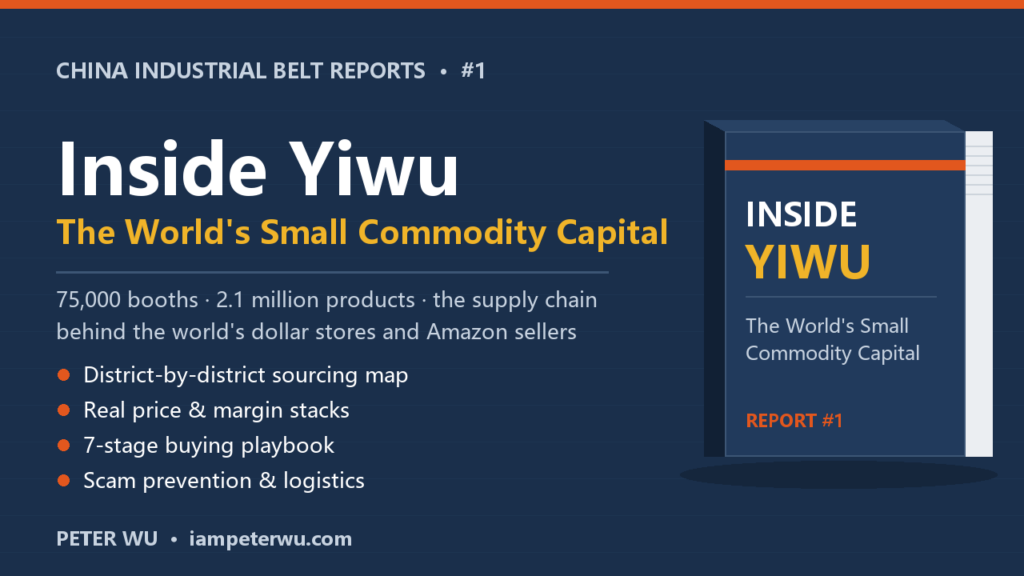
Inside Yiwu: The World’s Small Commodity Capital — China Industrial Belt Report #1 — instant PDF, $10, free lifetime updates to this edition.
FAQ
What’s the minimum budget to test Yiwu seriously?
A mixed LCL test (5–8 m³) lands around $3,000–8,000 in goods plus $1,500–3,000 in freight and fees. Below that, start with an air-shipped sample basket ($500–1,500).
Do I need a sourcing agent or can I go direct?
You’ll use an export agent regardless (booths can’t take foreign currency). The question is whether you also want a sourcing agent to manage suppliers — worth it for OEM orders, optional for in-stock buying.
How long from order to delivery?
In-stock goods: 1–2 weeks to production/consolidation + freight time (25–45 days sea to US). Custom OEM: 25–45 days production + freight. Plan launch dates backwards from these numbers.
Peter Wu writes field-tested reports on China’s industrial belts at iampeterwu.com. Next report in the series: Shenzhen’s Huaqiangbei electronics market.
More in the series: What Is Huaqiangbei? · How to Buy Components in Huaqiangbei · Huaqiangbei vs Alibaba vs LCSC