Estimated reading time: 9 minutes.
Every hardware buyer eventually faces the same fork: order components from an authorized distributor, roll the dice on a marketplace, or go to the source in Shenzhen. The honest answer is that each channel solves a different problem, and the buyers who lose money are the ones who use the wrong channel for their stage. Here’s the comparison I wish someone had handed me before my first BOM.
The three channels in one table
| Dimension | Huaqiangbei (market) | Alibaba / AliExpress | LCSC & authorized distributors |
|---|---|---|---|
| What it is | Physical gray+white market, 300k+ traders | Marketplace of sellers, opaque tiers | Authorized distribution (LCSC, Arrow, Digi-Key equivalents) |
| Price at small qty | Lowest for original-tier; 散新 cheaper still | Mid, with quality lottery | Highest list price, volume breaks |
| Lead time | Same day (in stock) | Days–weeks | Days (in stock) to 8–16 weeks (allocation) |
| Traceability | Optional (tier-dependent) | Poor | Full, with certificates |
| Breadth | Deepest on earth, incl. EOL parts | Broad but shallow per part | Broad for current parts only |
| Main risk | Counterfeits without testing | Mislabeling, no recourse | Price, allocation delays |
What Huaqiangbei actually sells you
The market’s product is not components — it’s availability. Same-day stock on parts that authorized distributors quote at 8–16 weeks; the deepest inventory of end-of-life and obscure parts on earth; and a tier system that lets you choose your price/risk point per line item (see What Is Huaqiangbei? for the tier breakdown).
A real comparison for a $0.60-list ARM microcontroller at 100 pcs:
- LCSC/authorized: ~$0.80–1.00, ships in days if stocked — allocation delays otherwise
- Huaqiangbei original/new: ~$0.65–0.80, same day
- Huaqiangbei 散新: ~$0.25–0.40, same day, no traceability
The market wins on speed and price; it demands process (tier discipline, testing) in exchange.
What the marketplaces are good for
Alibaba/AliExpress are convenience channels: English UI, small quantities, shipping to your door. The catch is the quality lottery — marketplace sellers mix tiers without labeling them, and “original” is a keyword, not a guarantee. For modules, cables, and accessories at small scale, fine. For ICs in anything that matters, you’re buying hope.
LCSC and authorized distributors are the traceability channel: certificates of conformity, date codes you can trust, and reclamation support when things fail. The costs: higher list prices at small quantities, and — the real pain in 2024–2026 — allocation. When a part goes into shortage, authorized lead times stretch to quarters while Huaqiangbei counters reprice by the hour. If your product launch depends on a constrained part, the gray market may be the only market.
The decision framework (per line item, not per project)
Sophisticated buyers don’t pick a channel — they route each BOM line:
- Critical parts (MCU, RF, power): authorized distributor if lead time allows; Huaqiangbei original-tier + third-party testing when it doesn’t.
- Commodity passives/connectors: cheapest acceptable source — often the market’s gray tiers are perfectly rational here.
- EOL/obsolete parts: Huaqiangbei is frequently the only source with stock.
- Modules and accessories: marketplace or market, priced accordingly.
- Volume >1,000 pcs of a stable part: negotiate with domestic authorized agents; the market’s edge fades with volume.
And the channels nest: experienced Huaqiangbei agents quietly source from LCSC when it’s cheaper, and market counters stock pulled boards from the same factories Alibaba sellers list. You’re not choosing a team — you’re paying the smallest premium for the service each line item needs.
The failure tax, again
Whichever channel you choose, remember the dominant cost for new buyers is failure cost, not unit price. A 30% saving on gray-tier parts means nothing if 5% of them are dead on arrival and your launch slips a month. Route critical lines through traceable channels or tested gray channels — never untested gray.
Going deeper
The full field guide — building maps, the component tier system, testing labs, pilot orders, and the pilot-to-production path — is in:
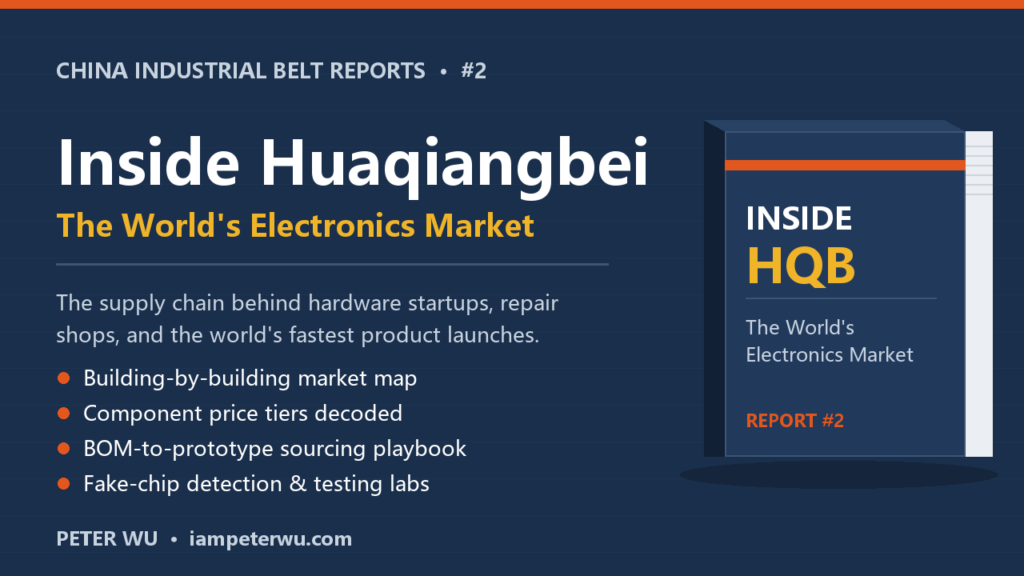
Inside Huaqiangbei: The World’s Electronics Market — China Industrial Belt Report #2 — instant PDF, $10, free updates to future revisions.
New to China sourcing altogether? Start with the free China Industrial Belt Map 2026. Coming from general merchandise? The Yiwu vs 1688 vs Factory Direct framework applies the same per-line-item logic to consumer goods.
FAQ
Is LCSC cheaper than Huaqiangbei?
Rarely at small quantities — LCSC is the traceability premium channel. On constrained parts, though, Huaqiangbei’s premium can be brutal (shortage pricing), and authorized stock at list is the cheaper outcome.
Can I trust “original” claims on Alibaba?
Treat them as marketing. Marketplace tiers are unlabeled; assume nothing, test anything critical.
What about Taobao?
Taobao is the domestic retail layer — excellent for accessories and modules if you read Chinese, hard for foreigners without an agent. Huaqiangbei counters largely run Taobao storefronts anyway; the same goods, one handshake of markup.
More in the series: How to Source from Yiwu: The Small-Buyer Playbook
*Peter Wu writes field-tested reports
If you source consumer goods as well as components, Inside Yiwu explains the aggregation model behind the world’s dollar stores.
on China’s industrial belts at iampeterwu.com. Get the Huaqiangbei report here, or read the component buying playbook.*