Estimated reading time: 8 minutes. Part of the China Industrial Belt series.
Ask someone to name the center of global consumer goods and they’ll say Shenzhen, or Guangzhou, or “somewhere in China.” Almost nobody says Yiwu — a city of 1.9 million people in Zhejiang Province that most people outside the trade can’t place on a map. And yet the Yiwu wholesale market is the single largest concentration of consumer products on earth: roughly 75,000 booths displaying an estimated 2.1 million products across 2,100+ categories.
If you’ve ever bought Christmas lights, birthday candles, phone cases, socks, hair clips, or a souvenir keychain, there’s a good chance your purchase passed through this building complex. Industry estimates put around 80% of the world’s Christmas decorations through Yiwu’s hands.
Here’s how the place actually works — not the YouTube-tour version, the operational one.
What the Yiwu International Trade City really is
Locals call it Futian Market (福田市场). Officially: the Yiwu International Trade City, five districts covering about 6.4 million square meters. The first thing first-time visitors misunderstand is that Yiwu is a marketplace, not a factory. Each booth is typically a one-to-three-person trading office: a desk, product racks, a phone, and a factory relationship 50–300 kilometers away. Manufacturing happens across Zhejiang and neighboring provinces — for example, the nearby town of Datang alone produces roughly 70% of the world’s socks.
What Yiwu sells, fundamentally, is aggregation. A buyer can walk three districts in one day, collect 150 SKUs from 30 suppliers, and hand everything to a licensed export agent who consolidates it into one customs-cleared container. No other sourcing destination on earth offers that breadth-per-kilometer — and it’s why small commodities have stayed sticky in Yiwu even as other manufacturing migrates elsewhere.
How the market is organized
This is the part most guides get wrong, and it costs visitors entire days. The five districts are organized by category:
| District | What you’ll find |
|---|---|
| 1 | Toys, artificial flowers, jewelry & accessories, festive/Christmas items |
| 2 | Hardware & tools, umbrellas, bags & luggage, stationery, sporting goods |
| 3 | Office & school supplies, cosmetics, eyewear, watches, apparel trim |
| 4 | Socks & hosiery, apparel, textiles, gloves, hats, shoes — the largest district |
| 5 | Bedding & home textiles, kitchenware, auto accessories, plus an imported-goods pavilion |
Booths are numbered district–section–booth (e.g., 2-45-B123). Photograph booth cards and product tags as you go; the market is a maze by design — more product per square meter than anywhere else.
The price stack: where the money actually goes
The most useful thing to understand about Yiwu economics is that every product has four prices:
- Ex-factory — what the producing workshop charges
- Booth/wholesale price — typically +5–15% over ex-factory
- FOB Ningbo — +3–8% for trucking, export clearance, port handling
- CIF/DDP to your door — +10–30% depending on freight and duties
A worked example. A 10-meter USB LED string light retails at $3.99–6.99 in the US. Ex-factory in Zhejiang: about $0.22–0.31. Yiwu booth price at 100-carton quantity: $0.28–0.37. That’s a 15–25× retail multiple — and it’s typical for the category. This is why dollar stores and Amazon resellers can absorb tariffs and freight spikes and still operate: the value-add happens downstream of Yiwu.
For small buyers, Yiwu’s hidden advantage is minimum order quantities. In-stock items commonly have MOQs of 1–5 cartons — sometimes by the dozen — which means you can assemble a genuinely mixed test container. Custom/OEM runs are different: expect 500–3,000 units per SKU, with custom printed packaging usually the binding constraint.
Who buys here
Five archetypes you’ll pass on the floor:
- Container traders from Africa and the Middle East — hundreds of mixed SKUs per container, shipping monthly to wholesale markets in Lagos, Dubai, Riyadh.
- Latin American wholesalers — Christmas, toys, household goods, two to four timed visits a year.
- Amazon FBA and e-commerce sellers — smaller volumes, higher quality bars, and a growing obsession with compliance documents.
- Retail chain buyers — audited factories, test reports, indemnities.
- Researchers and creators — the YouTubers touring “the supermarket of the world.” Their view counts are themselves a signal of Yiwu’s brand power.
The fastest-growing and least saturated group is #3 — and Yiwu’s suppliers have adapted: compliance documentation, neutral English packaging, and small-batch flexibility are dramatically better than five years ago.
The part nobody shows you: risk
Yiwu rewards process and punishes improvisation. The honest truth is that outright fraud is rare; most buyer losses come from specification drift — a production run that’s quietly thinner, lighter, or cheaper than the sample — and from skipped pre-shipment inspections. The disciplines that work: verify every supplier’s business license (营业执照), pay only verified corporate accounts against milestones, keep a golden sample, and never pay the final balance before inspection. That’s true whether you’re buying $2,000 or $200,000.
Going deeper
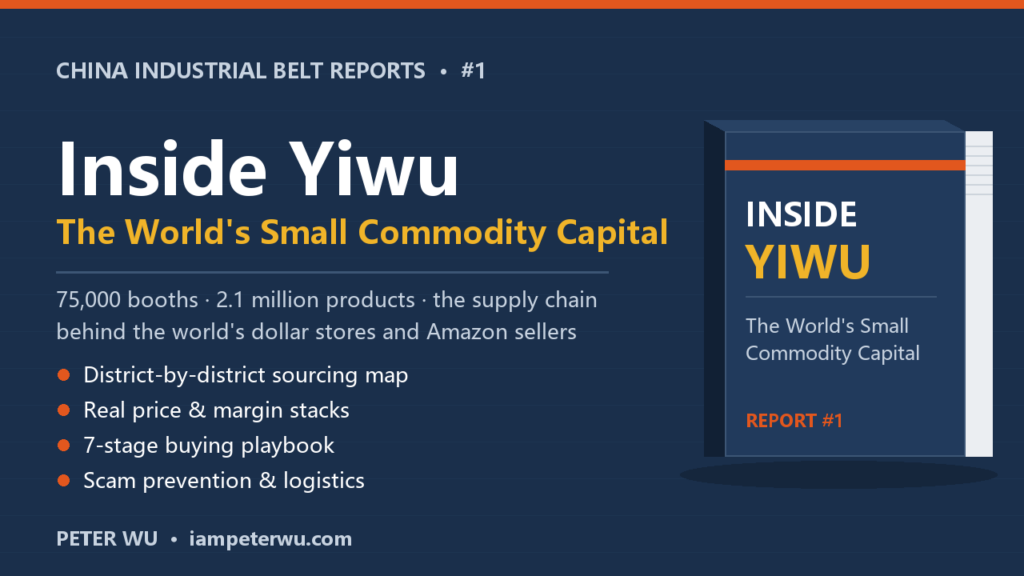
This post is the short version. The full playbook — including a 7-stage sourcing process, the seven most common scams and their antidotes, the logistics decision framework (sea vs. the Yiwu–Europe rail), and the 2025–2026 trend map — is in my report:
Inside Yiwu: The World’s Small Commodity Capital — China Industrial Belt Report #1 — instant PDF, $10, free updates to future revisions.
Prefer a free step-by-step process first? Read the small-buyer sourcing playbook.
It’s the document I wish existed when I started researching China’s industrial belts: structured, field-tested, and zero hype. Next in the series: Shenzhen’s Huaqiangbei and the hardware startup supply chain.
FAQ
Do I need to visit Yiwu to buy from it?
Not anymore. Remote buying via the official Chinagoods platform and licensed agents works for repeat orders; a first visit still pays for itself once yearly volume passes roughly $20–30k.
Is Yiwu affected by US tariffs?
Yes — landed costs and category mixes have shifted. But small commodities are structurally hard to re-source because Yiwu’s advantage is ecosystem density, not labor cost. Build duty into your landed-cost model from day one.
What’s the difference between Yiwu and 1688.com?
1688 is factory-direct domestic trade: cheaper, higher MOQs, no export service. Yiwu is an aggregation layer with export machinery built for foreign buyers. Many experienced buyers use Yiwu agents who source partly from 1688 — you’re paying for curation and export capability. See the full channel comparison: Yiwu vs 1688 vs Factory Direct.
Peter Wu writes field-tested reports on China’s industrial belts at iampeterwu.com. Follow the blog for the next issue in the series.
More in the series: What Is Huaqiangbei? · How to Buy Components in Huaqiangbei · Huaqiangbei vs Alibaba vs LCSC